





MBBS in UK for Indian Students: All You Need to Know for 2027
Contents

Benefits of Studying MBBS in the UK for Indian Students

After an MBBS in the UK: Postgrad and career

Types of Medicine Degrees in the UK

MBBS in the UK Explained

Top-ranking Universities in the UK for MBBS

MBBS in the UK: Most Affordable Colleges for Medicine

MBBS in the UK: MCI Recognised Universities

Eligibility Criteria for MBBS in the UK for Indian Students

Cost of Studying an MBBS in the UK as an Indian Student

Scholarships for Indian Students Applying for MBBS in the UK

Funding Support for Indian MBBS Students in the UK

Applying for an MBBS in the UK as an Indian Student

Acquiring Your UK Student Visa for Your MBBS Studies
Final Checklist for MBBS Students before Departure

FAQs
Studying MBBS in the UK offers Indian students a globally recognised medical degree with excellent career prospects and multiple pathways to practice worldwide.
- Top-ranked universities, including Oxford, Cambridge, and Imperial College London, offer world-class education, with 5–6 year programmes combining theoretical knowledge and extensive NHS clinical placements
- Flexible practice options allow you to work in the UK without the PLAB exam, or return to India and register with the NMC without clearing the FMGE
- The UK provides strong career prospects with foundation doctors earning £38,831–44,439/year and specialists earning £70,000–100,000+, plus opportunities for postgraduate specialisation in high-demand fields
- The application pathway is straightforward through UCAS (maximum 4 medicine choices), requiring 80–95% in Chemistry and Biology, UCAT scores of 2,100+, and IELTS 7.0–7.5
- Total costs range from £30,000 to £70,000+ annually for tuition, with scholarships, loans, and part-time work available to support your studies
Studying MBBS in the UK is a dream for thousands of Indian students—and with good reason. The UK offers world-renowned medical schools, advanced clinical training, and qualifications recognised across the globe. For aspiring doctors, it provides a trusted pathway to becoming a globally competent professional.
This comprehensive guide covers everything you need to know before applying: eligibility, application timelines, top universities, tuition fees, scholarships, visas, and career opportunities.
Whether you’re just exploring your options or ready to apply, it’s designed to help you make informed, confident decisions at every stage.
Benefits of Studying MBBS in the UK for Indian Students
Education benefits of UK MBBS
- Study at top-ranking medical schools in the UK
- Earn a medical degree recognised by global medical councils
- Learn in state-of-the-art facilities with advanced medical technologies
- Access research opportunities and evidence-based teaching
Career benefits of UK MBBS
- Gain extensive clinical experience through NHS placements
- Choose from diverse career pathways in the UK and internationally
- Enjoy high earning potential and strong employability
- Practise in India without needing to clear the FMGE
Social benefits of UK MBBS
- Build a global peer network and professional connections
- Learn in a diverse and welcoming environment
- Get support from tailored services for Indian students
📌 In our Why Study MBBS in the UK guide, we explore these unique benefits in more detail—from employability to earning potential as an MBBS graduate from a UK university.
After an MBBS in the UK: Postgrad and Career
An MBBS from the UK opens diverse career and postgraduate study opportunities both in the UK and globally, thanks to its strong academic reputation, comprehensive training, and international recognition. Graduates can pursue:
- Clinical practice in the UK, India, or other countries (subject to local licensing exams)
- Specialist medical training in high-demand fields
- Medical research or academic roles
Earning Potential After MBBS in the UK
Entry-level (Post-MBBS):
- Foundation training (Residency): £38,831–44,439/year
- Specialist training: £52,656–73,992/year
Experienced professionals:
Profession
Average annual salary*
Cardiologist
£102,063
Dermatologist
£70,000
Family Physician
£68,784
General Practitioner
£81,315
Gynecologist
£81,422
Neurosurgeon
£96,478
*Sourced from PayScale in February 2026.
Practising medicine in the UK as an Indian Student
UK MBBS graduates do not need to take the PLAB (Professional and Linguistic Assessment Board) exam, but they must complete the following steps:
Step
Requirement
Register with the GMC
Apply for provisional registration with the General Medical Council (GMC) during your final year.
Why: Allows you to work as a junior doctor in a Foundation Programme (F1).
Provide primary medical qualification
Submit proof of your MBBS degree (5–6 years).
Why: Confirms eligibility to practise medicine.
Show English language proficiency
Meet required scores in an accepted English test.
Why: Ensures ability to practise safely in English-speaking settings.
Explain gap year
(if applicable)
Justify any breaks of one year or more post-graduation.
Why: Maintains professional credibility.
Detail last 5 years of activity
Provide a record of medical/non-medical education, training, or work.
Why: Verifies professional continuity and experience.
MBBS graduates have global career mobility with minimal barriers in certain countries including India. If you wish to return home and begin your medical career, you have the opportunity to do so by simply registering at the NMC.
Postgraduate studies after an MBBS in the UK
Pursuing a medical specialisation after your MBBS can significantly boost your career prospects, including opportunities for higher salaries and leadership roles. The UK offers a range of clinical specialisations for you to choose from, depending on your interests and goals. Popular specialisations include:
- Internal medicine
- Gynaecology
- Radiology
- General surgery
- Oncology
- Diabetes
Whether your goal is to practise in the UK, return to India, or work internationally, postgraduate study builds on your MBBS foundation, enhances expertise, and expands career opportunities.
📌 Spotlight: PG prospects after MBBS in the UK
- 🎓 In-demand specialisations
- 💰 Competitive salaries (£70,000–100,000+)
- 🌍 International career mobility
Full guide in:
Types of Medicine Degrees in the UK
Undergraduate
- Qualification: Bachelor of Medicine, Bachelor of Surgery (MBBS)
- Purpose: Build comprehensive medical knowledge and clinical skills tobecome a practising doctor
- Duration: Typically 5–6 years
- Admission requirements:
- High grades in science subjects (Biology, chemistry, physics/mathematics)
- Competitive entry process with aptitude tests (e.g., UCAT; NEET for Indian applicants
- Outcome: Eligibility to begin clinical practice or pursue postgraduate specialisation
Postgraduate
- Qualification:
- MD (Doctor of Medicine): Advanced clinical and research training.
- MSc (Master of Science): Focus on specialised areas of medicine or medical sciences
- Postgraduate diplomas and certificates
- Purpose: Gain knowledge and experience in a specific area of medicine
- Duration: 1–2 years (full-time) or 2–4 years (part-time)
- Admission requirements: Undergraduate qualification and professional experience
- Outcome: Specialisation in a chosen medical field, career advancement, or academic roles
Doctorate
- Qualification: PhD in Medicine
- Purpose: Conduct original research in specific areas of medicine
- Duration: 3–4 years (full-time) 6–7 years (part-time)
- Admission requirements: Undergraduate degree with first classhonours/postgraduate degree, professional experience, research background preferred
- Outcome: In-depth research in a specific area of medicine. Often leads to careers in medical research, university teaching, or high-level medical innovation
Learn more in:
MBBS in the UK Explained
The MBBS qualification at medical colleges in the UK is denoted in a few different ways:
- BMBS
- MBChB
- MB BCh
- MB BChir
Although the degree is represented differently, they all refer to the same qualification, offering the same comprehensive and hands-on education that helps you work towards becoming a highly skilled doctor.
MBBS in the UK: course content
- Year 0: Foundational year covering English for medical sciences, scientific communication in medicine, and investigative skills
- Year 1–2: Pre-clinical education in principles of medicine, human anatomy, human behaviour, and more.
- Year 3–6: Clinical education covering Medicine in clinical practice, Anaesthesia and critical care, pathology, immunology, and more.
- Internship/ Residency: 12-18 months of practical training in medicine and surgery (equivalent to Foundation Year 1 in the UK)
💡 Spotlight: UK MBBS Journey

Clinical and pre-clinical studies

NHS placements

Foundation year training after graduation
Find a year-by-year breakdown in:
Top-ranking Universities in the UK for MBBS
The leading universities for medical studies in the UK are renowned for their high-quality education and recognised by major medical councils worldwide, making them a trusted choice for aspiring doctors seeking global career opportunities.
1
Pre-clinical: £49,400
Clinical: £65,250
2
£58,600
Hull York Medical School, University of York
3
£49,750
5
£70,554
Explore the full list in
MBBS in the UK: Most Affordable Colleges for Medicine
These UK colleges offer low-cost MBBS programmes in the UK. If you want to learn more, our guide on the cheapest MBBS in the UK can help.
Leicester Medical School, University of Leicester
8
£30,150
School of Medicine, Dentistry and Biomedical Sciences, Queen’s University Belfast
20
£39,200 + Levy
Faculty of Medicine, University of Southampton
21
£32,000
Explore the full list in:
MBBS in the UK: MCI Recognised Universities
‘MCI Recognised’ or ‘MCI Approved’ refers to colleges whose MBBS programmes have been assessed and accepted by the Medical Council of India (MCI). According to the National Medical Commission (NMC), if you pursue an MBBS in an MCI-recognised college, you have the chance to register at the NMC as a practising doctor without sitting for the Foreign Medical Graduates Examination (FMGE). Here’s a list of MCI-approved universities in the UK that you can consider when researching MBBS programmes in the UK.
1
Pre-clinical: £49,400
Clinical: £65,250
£70,554
11
£45,800
14
£50,000
18
£62,730
💡 Spotlight: Top MBBS Universities in the UK

Global leaders

MCI-approved universities for practising in India

Affordable alternatives
Eligibility Criteria for MBBS in the UK for Indian Students
Getting into an MBBS programme in the UK is challenging because of the competitive entry requirements of UK medical universities. You need to show:
- Academic excellence in relevant subjects
- Top scores from UK clinical aptitude tests
- English language proficiency
Let’s go over them one by one.
Academic excellence in relevant subjects
You need to show strong academic performance in science subjects at the school level as an Indian student applying for MBBS in the UK. Most universities expect biology and chemistry as mandatory subjects, alongside high overall marks.
- Completion of 12th Standard with strong performance
- Core subjects:
- Mandatory: Biology and Chemistry
- Optional third subject: Physics, Mathematics, or another science-related subject
- Grades: UK universities generally expect scores in the 80–90%+ range for CBSE,
- ISC, and state boards.
Clinical aptitude tests
Universities evaluate candidates’ problem-solving, reasoning, and critical thinking skills through aptitude tests such as the UCAT (University Clinical Aptitude Test) and NEET (National Eligibility cum Entrance Test). These scores often determine whether you are shortlisted for interviews.
Applicants must complete at least one recognised medical entrance/aptitude test.
- UCAT
- Tests reasoning, problem-solving, and situational judgement skills
- Widely required for MBBS admissions in the UK
- NEET
- Required by the Medical Council of India for students intending to pursue medicine abroad
The BioMedical Admissions Test (BMAT) is another popular test used as part of the admissions process for medicine, biomedical sciences, and dentistry courses, but it’s no longer used as a test for MBBS applicants.
Depending on the university, you may need to submit both UCAT and NEET scores, or at a minimum, your UCAT scores.
English language proficiency tests
Since MBBS courses in the UK are taught entirely in English, demonstrating language proficiency through exams like IELTS, TOEFL, or PTE is essential.
- Common tests and minimum scores:
- IELTS Academic: Overall 7.0–7.5 (with 7.0+ in each band)
- TOEFL iBT: 100–110
- PTE Academic: 70–78
- If your secondary education in India was conducted in English, universities may accept high English marks in 12th Standard (CBSE/ISC) as proof instead.
To study MBBS in the UK as an Indian student, you need excellent school-level grades in science, strong UCAT (and NEET) results, and proven English proficiency. The exact criteria can change depending on the university, so it’s important to review the entry requirements of each MBBS programme you’re considering to confirm your eligibility.
📌 Ready to apply for MBBS in the UK? Our Eligibility and Application Guide walks you through the entry criteria and application process, so you can move forward with clarity and confidence.
Cost of Studying an MBBS in the UK as an Indian Student
- Tuition fees: Fees payable to your university each year. Note that clinical years may have a higher fee than the pre-clinical years.
- Pre-arrival costs: Costs before your departure to the UK like visa fees, proficiency test fees, etc.
- Living costs: The living expenses as a student in the UK, covering food, accommodation, travel, utilities, etc.
Based on the above breakdown, here’s an overview of costs you can expect as an Indian MBBS student in the UK.
£30,000 – £70,000+
Varies by university
£670
Minimum approximate
£12,645–18,945
Depending on location
£500–£1,000
Estimate
Note that these estimates vary depending on your choice of university, location of university, and your lifestyle.
*The overview is compiled referring to Cost of studying in the UK Student visa : Money you need – GOV.UK, Cost of studying in the UK, and Cost of Living in United Kingdom. Prices in United Kingdom. Updated Jan 2026, retrieved in February 2026
💡 Spotlight: Cost of Studying MBBS in the UK

Tuition fees:
£30,000–70,000+ per year

Diverse
accommodation options, including on-campus accommodation

Loans
Want to estimate your everyday expenses before making a decision? Explore our 2026 guide on the cost of living in the UK for Indian students.
Scholarships for Indian Students Applying for MBBS in the UK
You can apply for a variety of scholarships in the UK as an Indian MBBS student. These scholarships can help you lower the financial investment of studying an MBBS in the UK, as most scholarships offer tuition fee discounts and allowances for travel, consumables, and more. Here’s a list of MBBS scholarships you may be eligible for as an Indian student.
- Hull York Medical School International Excellence Scholarship
- International Undergraduate Excellence Scholarship
- UCL Global Undergraduate Scholarship
- UCL Medical Student Money
Want to explore more scholarship opportunities as an Indian MBBS student and learn how to apply? Check out our Costs and Funding Guide.
Although some UK scholarships popular among Indian students have been cited by many resources as medicine scholarships, many are not applicable to MBBS programmes in the UK. Here’s a list of scholarships not offered for undergraduate medical studies in the UK.
- Birmingham India High Fliers Undergraduate Scholarships: Not applicable to the medicine (MBChB) programme
- Chevening Scholarships: Master’s studies only
- Commonwealth Scholarships: Postgraduate studies only
- Imperial College London: Home (UK resident) students only
- Inlaks Scholarships: Postgraduate studies only
- King’s College London Scholarships: Postgraduate studies only
- Rhodes Scholarship: Postgraduate studies only
Want to find out more about scholarships you may be eligible for? Our scholarship search can help.
Eligibility criteria for MBBS scholarships
Scholarships offered for international applicants in the UK usually have specific admission requirements related to nationality, programme of study, and level of study. Alongside these, students are generally expected to meet the following common criteria:
- Demonstrate financial need
- Have outstanding academic records
- Qualify for overseas tuition fee
- Hold an unconditional offer
- Use personal funds to support studies
Some scholarships are awarded automatically once tuition fee payment is completed, while others require a separate application through UCAS or directly with the university.
Not sure which scholarships you’re eligible for or how to apply? Schedule a free counselling session to get personalised guidance from our experts.
Even if you don’t secure a scholarship, there are still ways to manage the cost of studying MBBS in the UK. Let’s take a look at other funding options you can pursue to support your MBBS studies in the UK next.
Funding Support for Indian MBBS Students in the UK
Indian undergraduates can access additional funding options beyond scholarships to manage their finances while studying MBBS in the UK, either with financial aid offered by UK medical schools or part-time work.
- Loans and bursaries, either through the university or the NHS (National Health Service in the UK.
- Part-time jobs like healthcare assistance, medical, clerical work, tutoring, library assistance, etc.
Some universities do not permit Student visa holders to work while studying, so you may need to check with your university administration whether you are allowed to work part-time as a full-time overseas student.
Want to learn more about working part-time in the UK? Read our guide here: Your Guide To Part-time Jobs in the UK for International Students
Learn more about costs, scholarships, and funding your MBBS studies in the UK:
Once you’ve explored how to fund your studies in the UK, the next step is understanding the application process. Applying for an MBBS in the UK as an Indian student involves several key stages, from preparing documents to meeting UCAS deadlines.
Applying for an MBBS in the UK as an Indian Student
Most medical colleges in the UK accept applications through UCAS—the Universities and Colleges Admissions Service that manages undergraduate applications to UK universities. Through UCAS, you can apply to a maximum of four medical schools for MBBS programmes, so it’s important to research your options carefully and prepare your application well in advance.
The UCAS application process involves writing a strong personal statement, selecting courses, and presenting test scores that demonstrate your readiness for medical study. Understanding how this process works step by step will help you stay organised and avoid missing crucial deadlines.
Application process for an MBBS in the UK
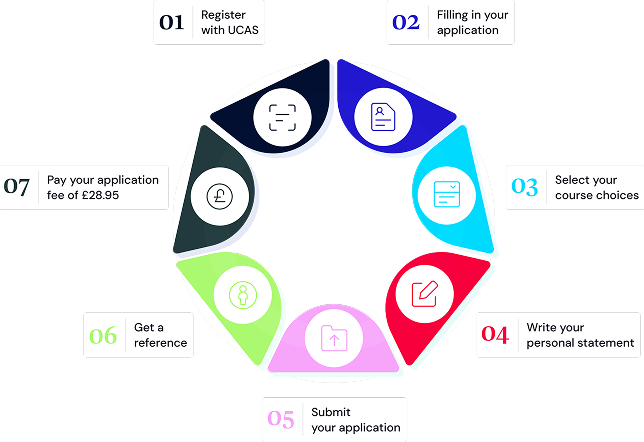
Read our Eligibility and Application Guide to learn more about the application process for a UK MBBS as an Indian student.
Documents needed to apply for an MBBS in the UK
When applying for an MBBS in the UK, you’ll need to submit several key documents. Each helps demonstrate your academic readiness, motivation, and ability to succeed in a UK medical programme.
Document
Preparing these documents carefully strengthens your application and shows your attention to detail—something UK medical schools value. If you’d like personalised guidance or expert feedback on your documents, you can connect with our counsellors through StudyIn’s free application services.
MBBS UK application timeline for Indian students
The following timeline can help you plan your application process, ensuring you are ready well in advance to meet the crucial deadlines like UCAS and visa application submissions.
- January – March (Year before entry)
- Research UK medical schools, entry requirements, and MCI/NMC recognition
- Shortlist universities (4 max for medicine via UCAS)
- Begin preparing for NEET or UCAT
- April – May
- Draft your personal statement
- Approach your chosen referee (teacher/mentor) for the written recommendation
- Register for UCAT (registration opens in May)
- June – August
- Sit for UCAT (test dates typically July–Sept)
- Take an English proficiency test (IELTS/TOEFL/PTE) if not already done
- Collect academic transcripts and get them verified for international submission
- September – October
- Finalise UCAS application: personal statement, recommendation, transcripts, test scores.
- Apply via UCAS (deadline mid-October for medicine)
- November – December
- Prepare for possible MMIs/interviews with universities
- Follow up with universities about additional documents or requirements
- January – March (Entry year)
- Receive conditional/unconditional offers
- Arrange student visa documents (CAS, financial proof, TB test, passport)
- April – July
- Apply for your UK Student visa
- Arrange accommodation and travel
- Attend a pre-departure briefing if available
- September
- Start your MBBS programme in the UK
📌 Need step-by-step help with your application? Book a free counselling session with StudyIn to get expert guidance from our team.
Once you’ve understood the application process for MBBS in the UK, you can start looking into how you can secure your student visa to study in the UK.
Acquiring Your UK Student Visa for Your MBBS Studies
Indian students entering the UK for medical studies must apply for a student visa, and while the process is straightforward, it does require careful preparation. Understanding what you need for the process in advance can make the entire experience smoother.
Document preparation checklist for your UK Student visa application
You’ll need the following documents to start your student visa application process with UK Visas and Immigration (UKVI).
- Copy of Passport
- Your CAS from your university
- Academic transcripts and certificates (original and English-translated copies, certified)
- English language proficiency test certificate
- Personal statement
- Academic reference letter (if required)
- Financial proof for visa application
- Your TB test results
- Written consent from your financial sponsor (if applicable)
With these documents in hand, you can begin your student visa application process to the UK. Here’s a step-by-step guide to acquiring your UK Student visa.
Visa application process to follow as an Indian MBBS student
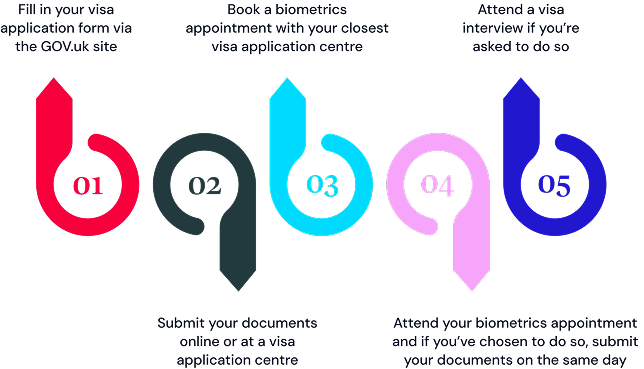
Learn about the UK student visa, including the documents you need, visa application process, and more from our comprehensive guide to UK Student visa for Indian MBBS students:
Final Checklist for MBBS Students before Departure
Before leaving for the UK, you can follow these steps to make sure you get a smooth and successful start.
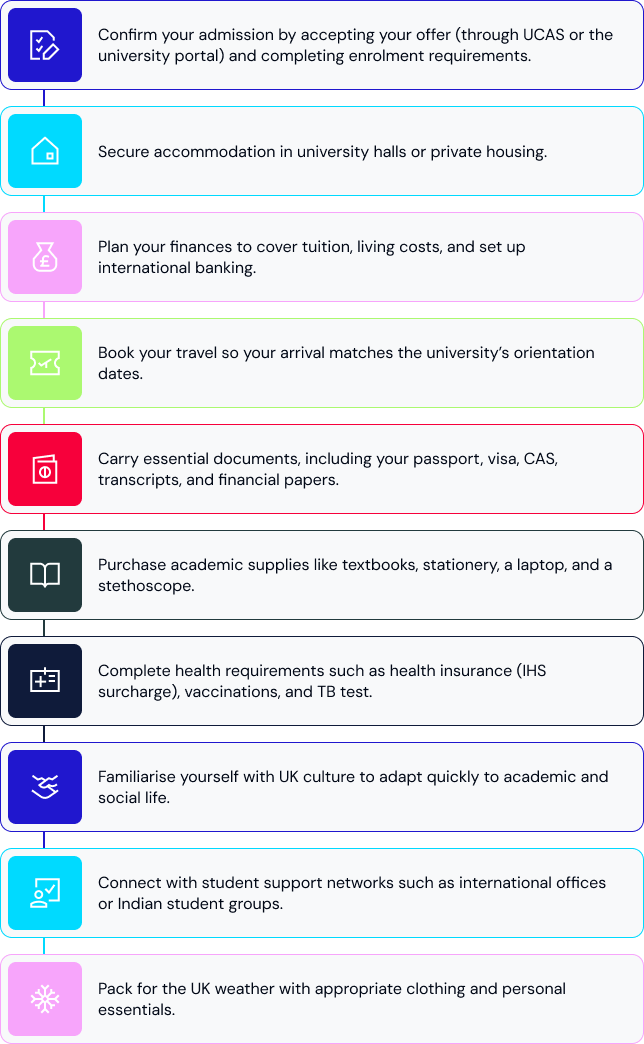
Completing these key steps will help you start your MBBS journey in the UK confidently and focus on your studies from day one.
If you are thinking of applying for an MBBS to study abroad in the UK, counsellors at StudyIn can help with our tailored service for medicine applicants. We have guided thousands of students in their research on medical schools in the UK, application support and helping them pursue their dream of becoming a UK-qualified doctor. If you need any information or support, reach out to us.
Refer to our detailed guides to learn all you need to know about studying an MBBS in the UK as an Indian student.
FAQs
Eligibility and entrance exams
Admission process
Fees, financial planning, and scholarships
Post-graduation and licensing
Miscellaneous
Menu

Find your preferred university
Find your preferred university
